
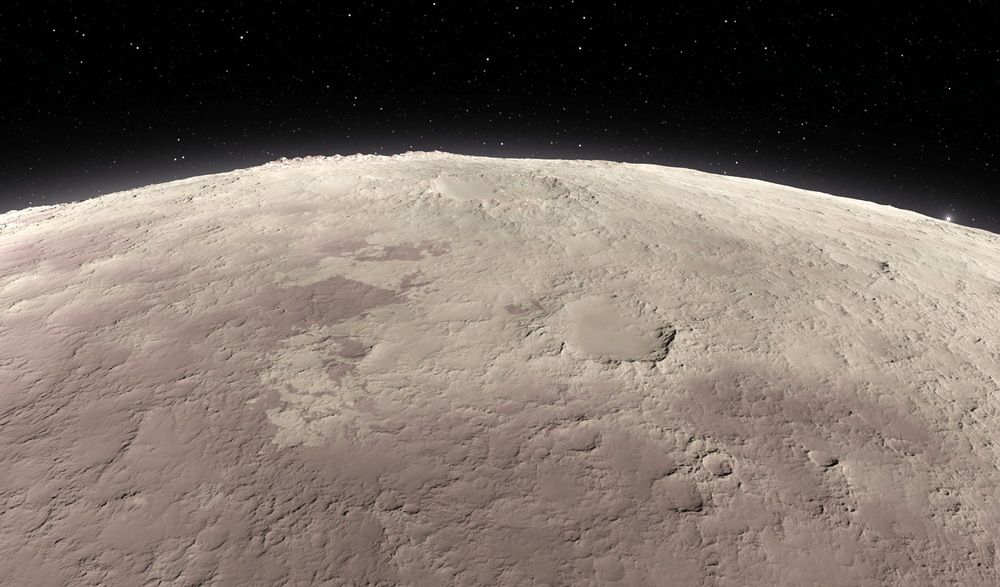
As we continue to send better exploratory technology to Mars using different rovers and take higher resolution pictures from satellites we are learning more and more about the planet. One thing that has been photographed for some time but not fully understood was the crater shaped circles on the surface of Mars. From far away these small circles appeared to be similar to how volcanoes look from far away on Earth. More recent pictures have shown up-close images of the craters and again they look very like volcanoes. So was the red planet partially formed by red hot lava or what are these formations telling us exactly?
The most recent pictures depict many thousands of these crater-like formations. They are conical hills with what appears to have once been small openings at the top (now closed over) and are surrounded by wide circles that were likely forged by a fast-flowing liquid. This lead scientists to the natural assumption that Mars had many volcanoes, similar to those we find on Earth. However, on Mars, nothing is quite as it seems.
Since then scientists have done many experiments and now appear to have decided that the flows were never lava but mud. While a little less exciting the fact that these mud volcanos exist on Mars tells us a lot about the planet and its formation.
Most findings of Mars are still just theories. The distant planet only leaves small clues that scientists must piece together in what is the most acceptable theory at the time. As we learn more we must constantly reevaluate what we thought we knew about the planet. Our methods are getting better and better though.
To determine how these mud volcanoes occurred, scientists recreated the conditions present on Mars in a vacuum setting. The group set up a low-pressure chamber with temperatures set to match Mars at -20 degrees celsius and importantly atmospheric pressure was set to seven millibars. Mars now existed on Earth. The team then poured some mud over sand and observed how the mud flowed. The water in the mud started to boil and dissolve. As a result, some latent heat was absorbed and the mud cooled and froze. Pretty strange.
This is not how mud acts on Earth. Of course, Mars is not Earth. Leading physicist Petr Broz said that the experiment shows how nothing can be taken for granted on Mars. Even something as simple as a mudflow, that we have all seen on Earth numerous times, occurs very differently on Mars. While the experiment goes a long way in explaining the mud volcanoes that have formed on the planet it does even more in showing us we have no idea what we are dealing with on Mars.
It is a strange idea to try to imagine a world completely different from our own. While we can prepare for freezing temperatures as it is a change on a spectrum that we constantly witness changes on, there are things that we are used to that we take as given on Earth that will change dramatically once we are on Mars. The average gravity on Mars is about 38% that of Earth but it also changes laterally. To plan for a different gravity is one thing, to plan for gravity that can change is something else entirely.
The experiment shows there are many things we are yet to comprehend about Mars and that much work is required before we are able to truly understand the planet and how to interact with it. While much work is planned for Mars in the coming years it will be a long time before we tame this strange beast.