
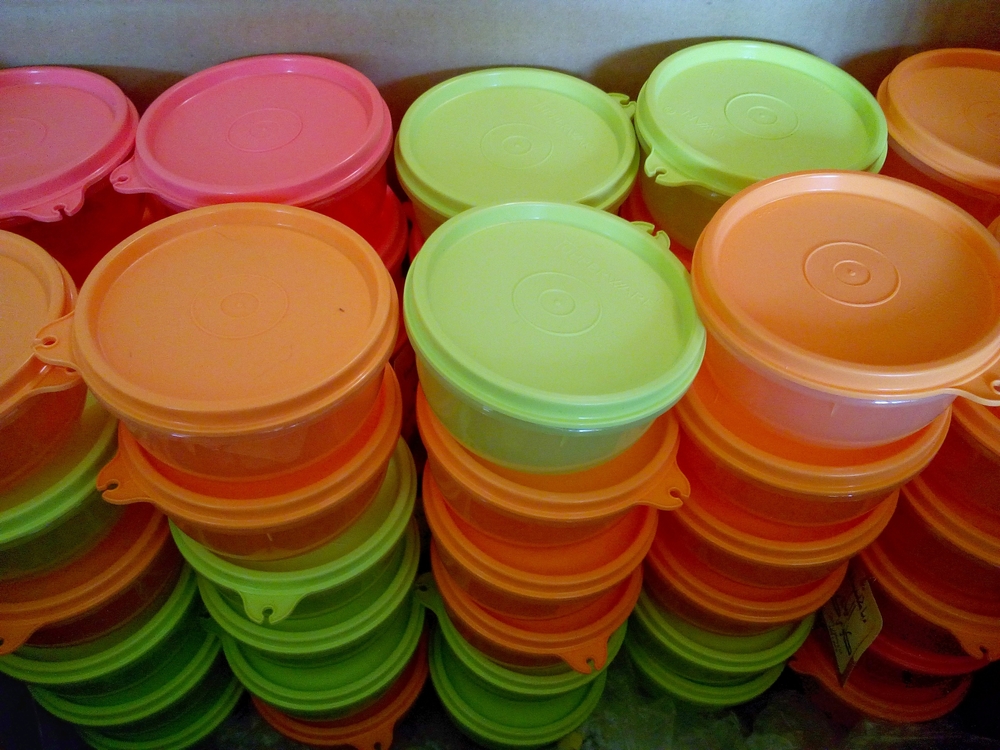
In 1945, if you wanted to preserve food for a few days in the refrigerator without the edges curling up and turning brown, or the entire thing going bad, you had a few options: you could cover it with a damp cloth; you could cover it with a shower cap, or you could cover it with a piece of wax paper or foil. There were also glass containers, which were not very cost-effective, and which would shatter into a million pieces when they were dropped.
Enter Earl Tupper, the man whose name became synonymous with the preservation of food. He tried to place an order for plastic resin from the Bakelite corporation that they were unable to fill for him. When he asked if they had anything else he could work with, they offered to give him a rubbery by-product of their petroleum refining process: black, oily lumps of polythene slag. They couldn’t find a use for it, and neither could DuPont, who also had huge quantities of the stuff lying around. They told Earl Tupper he could have all he wanted.
Tupper experimented with the stuff for months. He eventually came up with bright, colored kitchen items made from this “Poly T” as he called it, making cups, bowls, and other household items. He later patented the first spill-proof lids – an idea he got from the lids of paint cans – and called it the “Wonder Bowl.”
The idea did not catch on right away. People were used to plastics being oily, flammable, and smelly, due to the main ingredient used in plastics being formaldehyde. Plastics easily chipped and became warped in hot water; none of which were a problem with this new Tupperware. But most consumers didn’t bother to find this out, and most of the Tupperware just sat on the shelves.
This is where Stanley Home Products came in. Their sales model involved recruiting housewives to host parties at their homes to sell their mops, brushes, and cleaning supplies. Increasingly large numbers of Tupperware products were added to the Stanley home demonstrations, and their sales increased.
By 1950, a woman named Brownie Wise became one of the many Stanley salespeople to abandon their other home products and start exclusively selling Tupperware. She had begun ordering more than $150,000 worth of Tupperware to sell at home parties annually ($1.5 million today) at a time when Earl Tupper couldn’t sell it at all in department stores. In 1951, Tupper pulled his product from the department stores altogether and the only place you could buy this amazing new product was through the actual “Tupper lady” at home parties – since Earl Tupper held the patent for these and all resealable containers.
Today, Tupperware is a 4.2 billion dollar industry, selling the product in over 100 countries. They still use the sales techniques taught by Brownie Wise over half a century ago.