
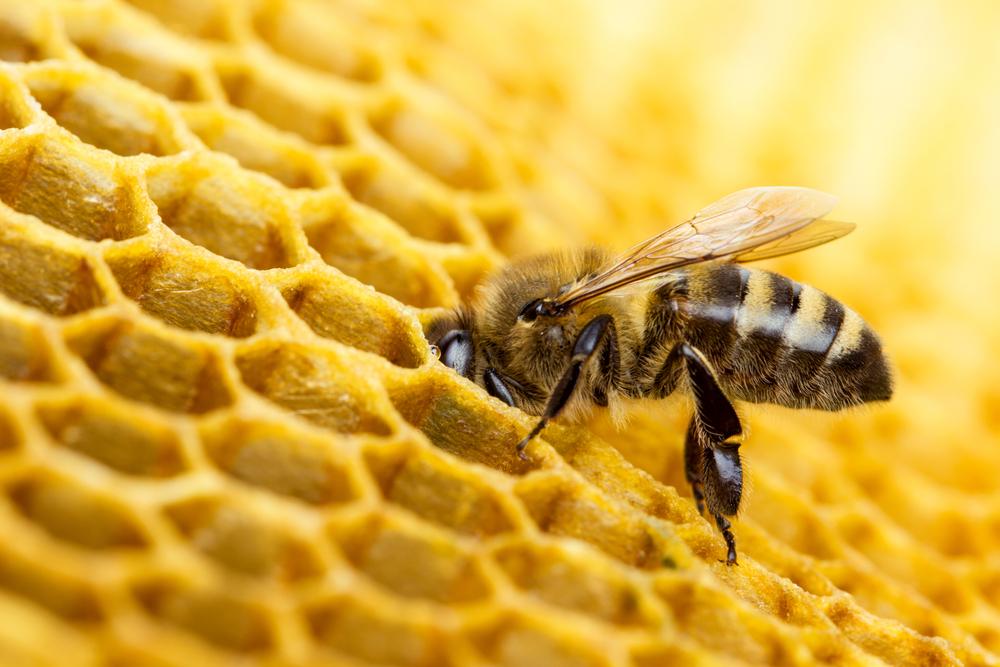
Bees may not be your cup of tea, but if you think about these highly intelligent insects and how they survive in nature, especially when it relates to their hive, you would be astounded. Bees are incredible at creating an ingenious design for their honeycomb.
Some of us have seen a beehive up close, but if you haven’t, the honeycomb represents the interior of the beehive or the insects’ home. It’s an enclosed cavity where the colony lives and raises their baby bees. During summertime, a beehive can contain as many as 50,000 to 80,000 bees.
Scientists have learned a lot about the beehive happenings and the fascinating interior structure of holes where these tiny buzzing creatures move about.
The honeycomb is comprised of a cluster of beeswax cells with each one having a hexagonal shape. It looks intricate, and bees are smart because the hexagon design is a solid one that may appear simple but is strong and long-lasting. However, the honeycomb interior does not start out in the brilliant hexagonal cells.

Most people probably don’t know this, but honeybees secrete the beeswax from their lower abdomen where several glandular openings are located. From there, the wax hardens on their “belly” and starts flaking off in scales or flat, clear pieces.
The next step is bizarre but makes bees quite unique in how they build an amazing honeycomb. The scales that flake off are then picked up by the worker bees that begin chewing them. The scales turn opaque as a result.
Scientists have discovered that the worker bees create the hexagon design first from a circular shaped cell as they chew the wax with their mandibles. Then, these insects are able to heat up the beeswax to make it flow like lava. Once the molten wax starts flowing, the cell walls naturally fall flat and take on the rounded hexagon form.

Bee experts haven’t been able to determine how bees go about heating each cell, but through research, scientists have calculated that the circular cells morph into hexagons within six seconds. It all remains quite a mystery. Interestingly, the hexagon design is often used naturally in nature. For instance, from plants to a turtle’s shell to a dragonfly’s eyes, each contains a unique hexagonal structure. Even snowflakes feature a hexagonal design.
Bees are constantly buzzing about and performing their important duties for nature. They work so hard pollinating crops worldwide. A worker bee will produce about 1/12th of a teaspoon of honey in her lifetime. In this case, a little goes a long way.